What is GRC Engineering?
GRC engineering is the practice of applying software engineering principles to governance, risk, and compliance. Instead of managing compliance through spreadsheets, manual evidence collection, and periodic audits, GRC engineers build automated systems that keep organizations continuously compliant.
GRC engineers write code. They build infrastructure-as-code templates that enforce security baselines. They create automated pipelines that collect compliance evidence in real time. They design dashboards that surface risk data from live systems rather than quarterly reports.
The core idea is simple: compliance should be engineered into systems from the start, not bolted on after the fact. When done right, GRC engineering transforms compliance from a cost center and bottleneck into a scalable, reliable function that runs alongside everything else.
GRC vs. GRC Engineering
The easiest way to understand GRC engineering is to compare it with traditional GRC.
| Dimension | Traditional GRC | GRC Engineering |
|---|---|---|
| Evidence Collection | Manual screenshots, emails, spreadsheets | Automated via APIs, cloud-native tools, and scripts |
| Control Monitoring | Point-in-time audits (quarterly/annually) | Continuous monitoring with real-time alerts |
| Infrastructure | Manual configuration, tribal knowledge | Infrastructure-as-code with compliance baked in |
| Tooling | GRC platforms, spreadsheets, document stores | Terraform, Python, AWS Config, CI/CD pipelines |
| Scalability | Linear: more controls = more people | Automated: more controls = more code |
| Audit Readiness | Weeks of preparation before each audit | Always audit-ready by design |
Traditional GRC is not going away. Organizations still need policies, frameworks, and audit expertise. GRC engineering builds on that foundation by making the execution scalable, repeatable, and reliable.
What GRC Engineers Actually Do
A GRC engineer's day-to-day work sits at the intersection of compliance knowledge and software engineering. Here's what the work looks like in practice:
- Build compliance-as-code: Write Terraform modules, CloudFormation templates, or policy-as-code rules that enforce security baselines across cloud environments.
- Automate evidence collection: Build pipelines that pull configuration data, access logs, and control status from AWS, Azure, or GCP APIs and map them to framework requirements.
- Design continuous monitoring: Set up AWS Config rules, CloudWatch alarms, or custom scripts that detect drift from compliant baselines and alert the right people.
- Create compliance dashboards: Build dashboards that show real-time control status, risk posture, and audit readiness using live data instead of stale spreadsheets.
- Map controls to frameworks: Translate technical configurations into framework language (SOC 2, ISO 27001, NIST 800-53, FedRAMP) so auditors and stakeholders understand the posture.
- Bridge security and engineering teams: Work with DevOps, platform, and security teams to embed compliance requirements into deployment pipelines without slowing down delivery.
Skills You Need for GRC Engineering
GRC engineering requires a blend of compliance domain knowledge and hands-on technical skills. You don't need to be an expert in everything on day one, but this is where the field is heading.
Cloud Platforms
- AWS (Config, CloudTrail, IAM, Lambda, Security Hub)
- Azure (Policy, Defender, Entra ID)
- GCP (Security Command Center, Organization Policies)
Infrastructure-as-Code
- Terraform
- AWS CloudFormation
- Pulumi
- Policy-as-code (OPA, Sentinel, AWS Config Rules)
Scripting & Automation
- Python
- Bash
- API integrations (REST, SDKs)
- CI/CD pipelines (GitHub Actions, GitLab CI)
Compliance Frameworks
- SOC 2
- ISO 27001
- NIST 800-53 / CSF
- FedRAMP
- HIPAA
- PCI DSS
Risk & Governance
- Risk assessment methodologies
- Control design and testing
- Audit preparation and response
- Third-party risk management
Communication
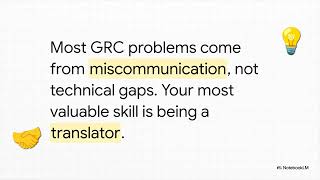
- Translating technical findings for business audiences
- Writing clear control descriptions
- Working across security, engineering, and executive teams
Tools & Frameworks
The GRC engineering toolchain is evolving fast. Here are the tools and frameworks that GRC engineers use most:
Terraform
Infrastructure-as-code for multi-cloud compliance baselines
AWS Config
Continuous compliance monitoring with managed and custom rules
AWS Security Hub
Aggregated findings mapped to compliance frameworks
Open Policy Agent (OPA)
Policy-as-code for admission control and configuration validation
Python
Automation scripts, API integrations, and custom compliance tooling
GitHub Actions
CI/CD pipelines with compliance gates and automated testing
OSCAL
NIST standard for machine-readable compliance documentation
CloudQuery / Steampipe
SQL-based cloud asset inventory and compliance queries
Prowler / ScoutSuite
Open-source cloud security posture assessment tools
Certifications for GRC Engineers
Certifications help validate your knowledge and open doors, especially when you're starting out. The best GRC engineers combine certifications with hands-on projects and a portfolio.
GRC Engineering Career Path
GRC engineering is a career that can start from many different backgrounds: traditional compliance, IT audit, cloud engineering, security operations, or even software development. Here's a typical progression:
Entry Level
GRC Analyst, Compliance Analyst, IT Auditor
Learn compliance frameworks, understand control objectives, start learning a cloud platform. Build your first automation scripts.
$70K - $100KMid Level
GRC Engineer, Compliance Engineer, Cloud Security Engineer
Build compliance automation, write infrastructure-as-code, design continuous monitoring. Own the technical compliance stack for your team.
$100K - $150KSenior
Senior GRC Engineer, Staff Compliance Engineer, GRC Architect
Architect compliance programs across multiple frameworks and cloud environments. Lead automation strategy and mentor junior engineers.
$140K - $180K+Leadership
GRC Engineering Manager, Director of Compliance Engineering, VP of GRC
Set the vision for how GRC engineering operates at scale. Build and lead teams. Influence company-wide security and compliance strategy.
$170K - $330K+How to Get Started in GRC Engineering
You don't need to know everything to start. Here's a practical roadmap:
Pick a cloud platform and learn the basics
AWS is the most common starting point. Get comfortable with IAM, VPC, S3, CloudTrail, and the console. Take the Cloud Practitioner exam if you want a milestone.
Learn a compliance framework
SOC 2 is the most in-demand for startups and SaaS. ISO 27001 for enterprise. NIST 800-53 or FedRAMP for government. Understand control objectives, not just control names.
Start automating
Write a Python script that checks a cloud configuration. Build an AWS Config rule. Create a Terraform module that deploys a compliant baseline. Start small and iterate.
Build a portfolio
Push your projects to GitHub. Write about what you built and why. A public portfolio of compliance automation projects is the single best differentiator in a job search.
Join a community
Learning alone is hard. The GRC Engineering Club gives you access to hands-on labs, mock interviews, resume reviews, and a crew of builders on the same path.
The structured version of this roadmap: the CGE-P
Steps 1 through 4 are the CGE-P curriculum. The Certified GRC Engineer Practitioner walks you through the cloud platform, the compliance frameworks, and the automation labs, and ends with a capstone project you ship on GitHub. Finish it and you have the portfolio from step 4 with a verifiable credential on top. It is free for GRC Engineering Club members and $350 on its own.
Explore the CGE-P curriculumIs GRC engineering a fad?
Tamelia Hutchinson, who has worked in security and compliance for about twenty years, joined Omar Sangurima on The AntiCheckbox Podcast. Episode: People Don't Scale: Tamelia Hutchinson on the 40 Year "Fad" of GRC Engineering.
Key points from the episode
- GRC engineering runs on two tracks, process and technical, and they feed each other. Neither is a fad. What changes is the tooling the industry uses to improve them, and that is the investment decision you are making.
- Software-led transformation stalls when the people receiving it cannot use it. Check your team's familiarity and comfort with the tools before you commit to them.
- Adopt change in chunks and shepherd people through it. A working example from inside the organization helps most. When there is none, ask stakeholders what their work would look like if their pain points were solved.
- Make the case in terms of the problem you solve and the value you add to the business, not only that something is more secure.
- A program that depends on a person cannot scale. Setup is the easy part. Maintenance is hard, because features and code keep shipping, and automation is how you keep up.
“People don't scale.”
Frequently Asked Questions
What is GRC engineering?
GRC engineering is the practice of building automated, scalable systems for governance, risk, and compliance instead of relying on manual checklists and spreadsheets. GRC engineers use infrastructure-as-code, cloud-native tools, CI/CD pipelines, and APIs to embed compliance controls directly into an organization's technology stack.
How do I break into GRC engineering?
Start by learning a cloud platform (AWS, Azure, or GCP) and a compliance framework (SOC 2, ISO 27001, or FedRAMP). Then build hands-on skills in infrastructure-as-code, scripting, and compliance automation. Join the GRC Engineering Club for labs, mock interviews, and a community of practitioners on the same path.
What is the difference between GRC and GRC engineering?
Traditional GRC focuses on policy writing, audit preparation, and manual evidence collection. GRC engineering applies software engineering principles to those same problems: automating evidence collection, codifying controls, building dashboards from live data, and treating compliance as a continuous process rather than a periodic audit.
What skills do you need for a GRC engineering career?
Key skills include cloud platform proficiency (AWS, Azure, GCP), infrastructure-as-code (Terraform, CloudFormation), scripting (Python, Bash), compliance frameworks (SOC 2, ISO 27001, NIST, FedRAMP), CI/CD pipelines, API integrations, and the ability to translate between technical and business teams.
What certifications help for GRC engineering?
Useful certifications include AWS Certified Security - Specialty, CompTIA Security+, CISSP, CISA, and cloud platform certifications. ISO 27001 Lead Auditor or Implementer certifications are also valuable. However, hands-on skills and a project portfolio often matter more than certifications alone.
How much do GRC engineers make?
GRC engineers earn between $70,000 and $330,000+ depending on experience, location, and specialization. Entry-level roles start at $70,000 to $100,000, mid-level engineers earn $100,000 to $150,000, and senior engineers regularly exceed $180,000. Leadership roles reach $330,000+, a figure verified by a GRC engineer in the GRC Engineering Club. The field is growing rapidly as organizations shift from manual compliance to engineered systems.
Is GRC engineering a good career?
Yes. GRC engineering is one of the fastest-growing niches in cybersecurity. Every company that handles sensitive data needs compliance, and organizations are increasingly looking for engineers who can automate and scale those programs rather than manage them manually. Demand far outpaces supply.